IP address management: know where every address is used.
Register IPv4 and IPv6 blocks in one place. Addresses are assigned automatically when a server is provisioned and released when it is reclaimed, and ARP binding and source guard on the switch prevent conflicts and theft.
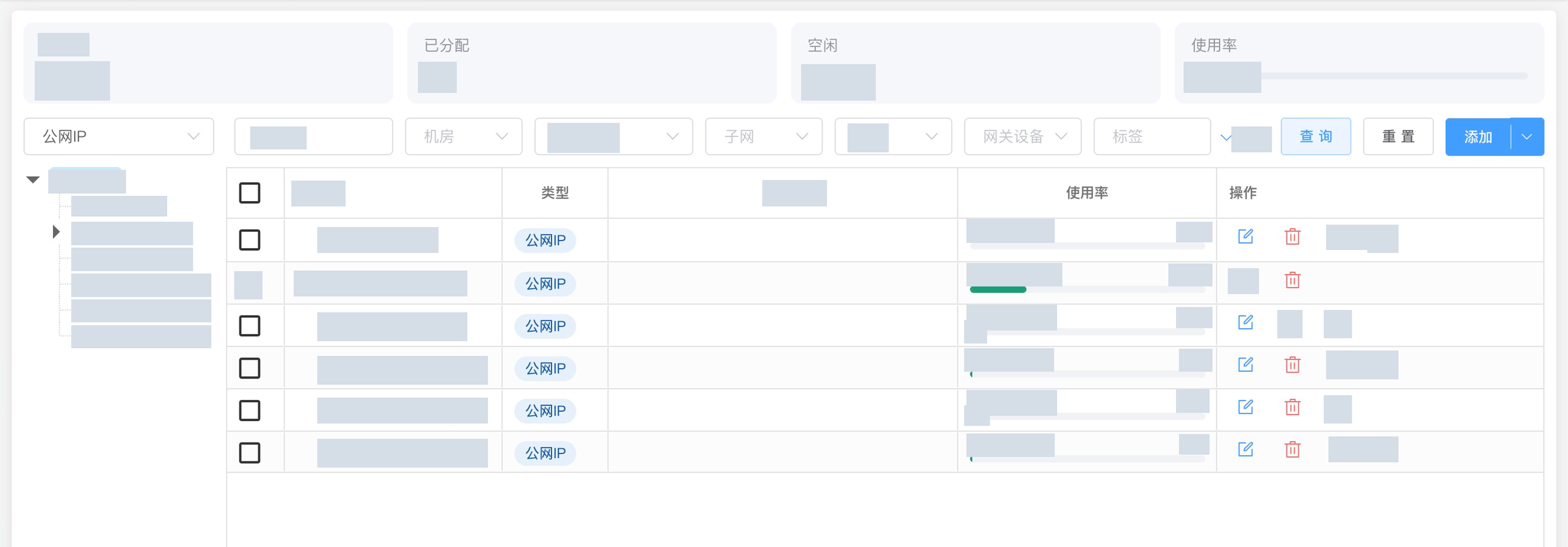
IPv4 address management (cropped) · Actual product interface · sensitive data redacted
Key capabilities
- 01
Add blocks by CIDR
Enter a block and DCIM works out the range, netmask and gateway, and can split large blocks into /24s.
- 02
Auto-assign and lock
Provisioning picks addresses from available blocks, while locked blocks stay reserved.
- 03
Native IPv6
Split IPv6 blocks by prefix length, assign subnets in bulk or generate a set number of addresses.
- 04
Theft prevention
ARP binding and source guard tie each IP to a MAC and a port, and spoofed traffic is dropped.
How address pools are organized
In DCIM, IP addresses are added as blocks. Enter a CIDR such as 103.45.12.0/24 and the system works out the first and last address and the netmask; the gateway can be the first or the last address. Each block can also have:
- Type: public, IPMI, customer private, internal, temporary or other;
- Data centers: a block can belong to several data centers at once;
- VLAN and gateway device: the VLAN the block lives in, and the routing switch that holds its gateway;
- DNS: two DNS servers per block;
- Groups and tags: organize blocks by carrier, customer or purpose for quick search.
Large blocks can be split into several /24s and managed separately.
Assignment, reclaiming and utilization
Addresses can be assigned one at a time or as a whole block to a server, with one address marked as primary. When a server is decommissioned or cancelled, setting its addresses back to free reclaims them.
A utilization chart in the list shows how much of each block is used and how much is left, so you can see which carrier is running out of addresses. Blocks with auto-assign enabled are used during automatic provisioning; locked blocks are left untouched.
IPv6
IPv6 blocks are also added by CIDR and can be split into smaller subnets by prefix length. Automatic splitting carves out a suitable subnet whenever a server needs one. You can also assign IPv6 subnets to servers in bulk, or generate a set number of addresses within a range.
Preventing IP conflicts and theft
“Borrowed” addresses are a common source of disputes for hosting providers. DCIM adds two safeguards on the switch:
- ARP binding: locks each IP to the MAC address of the server’s NIC, so another machine cannot use it;
- Source guard: the switch only forwards traffic whose source IP belongs to that port, and spoofed packets are dropped.
MAC addresses can be learned and bound automatically, so re-cabling and migrations no longer need manual checks.
IP address management
Does it support IPv6?
Yes. IPv6 blocks can be split by prefix length, assigned to servers as subnets in bulk, or used to generate a set number of addresses within a range.
How do you prevent duplicate assignments and IP theft?
Every address has a recorded owner, and automatic assignment skips addresses that are in use or locked. On the switch you can enable ARP binding and source guard so traffic with a spoofed source is dropped.
Can it manage IPMI management addresses too?
Yes. Blocks can be typed as public, IPMI, customer private, internal, temporary and more, and each type is counted and assigned separately.
See how it works in your data center.
Start with a product demo and map out your next step.
Hotline 400-112-2951